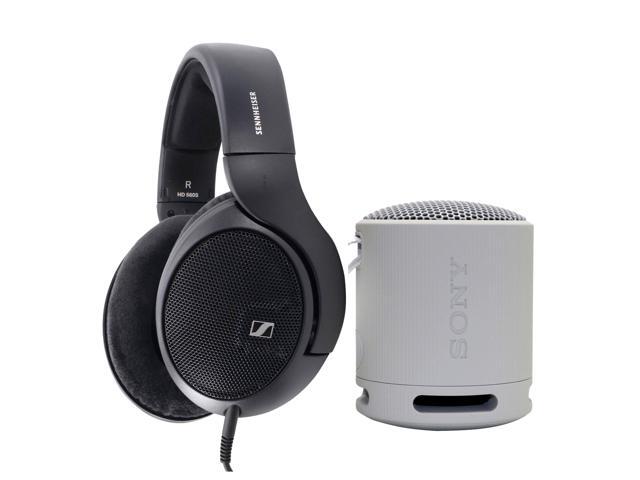
Why Open-Back Headphones Sound Different
If you’ve only used closed-back headphones or gaming headsets, putting on an open-back pair for the first time is a genuine revelation. The earcups have grilles instead of sealed shells. Sound escapes outward instead of bouncing around inside the cup. The result: a wider, more natural soundstage that makes music feel like it’s happening around you rather than inside your skull.
The trade-off is obvious. Everyone near you hears what you’re listening to. And you hear everything around you. Open-backs are for quiet rooms, home offices, and late-night listening sessions. Not coffee shops. Not open-plan offices.
The HD 560S is Sennheiser’s pitch for people ready to make that trade.
Sound Quality
I’ve been using the HD 560S as my primary headphones for six months. Music production, casual listening, gaming, movie watching. They replaced a pair of Audio-Technica ATH-M50x that served me well for years.
The difference was immediate. The first track I played (Radiohead’s “Everything In Its Right Place”) revealed layers of texture in the synth pads that the M50x had always smoothed over. Stereo separation was wider. The reverb tail on Thom Yorke’s voice decayed naturally instead of getting swallowed by the next note.
Bass: This is where the HD 560S surprised me. Open-backs have a reputation for thin low end. The 560S doesn’t have that problem. The frequency response reaches down to 6 Hz, and you can feel it. Kick drums have weight. Sub-bass in electronic music rumbles without bloating into the mids. It’s not the punchy, exaggerated bass of a gaming headset. It’s accurate bass. The kind where you hear what the producer actually put in the mix.
Mids: Clean and forward without being fatiguing. Vocals sit right where they should. Acoustic guitars have body and string detail. This is the range where the HD 560S earns its “reference” label. Nothing is boosted, nothing is recessed. You hear the recording.
Treble: Detailed and extended up to 38 kHz. Hi-hats shimmer, cymbals have air, and sibilance stays controlled. Some headphones in this class get harsh above 8 kHz. The 560S doesn’t. I’ve listened for hours without ear fatigue, which says a lot about how well Sennheiser tuned the upper frequencies.
Soundstage and Imaging
Open-back headphones live or die by their soundstage. The HD 560S delivers a wide, convincing presentation. Instruments have distinct positions in the stereo field. In orchestral recordings, you can point to where the first violins sit versus the cellos. In games, footsteps have directional accuracy that rivals dedicated gaming headsets.
I tested spatial audio in several FPS games over a few weeks. Positional accuracy was excellent. I could reliably locate enemies by sound in Counter-Strike and Valorant. The open-back design gives you more natural distance cues than any virtual surround processing.
For music mixing, the imaging is honest. Pan positions are precise. If something is 30% left in the mix, it sounds 30% left. That accuracy matters when you’re making EQ decisions or checking a mix for balance.
Comfort
At 240 grams, the HD 560S is light enough to forget you’re wearing headphones. The velour earpads are deep and soft, with enough room for large ears. They breathe well too. No sweaty ears after two hours of gaming.
The clamping force out of the box is moderate. Not too tight, not too loose. I have a larger head and didn’t need to stretch the headband. After a month of use, the clamp relaxed slightly and hit the sweet spot.
The headband padding is thin but adequate. Weight distribution is even enough that I don’t feel pressure points on top of my head. I regularly wear these for four to five hour stretches without discomfort.
One complaint: the headband and yokes are plastic. They flex and feel durable enough, but they don’t inspire the same confidence as the metal construction on Sennheiser’s HD 600 series. For the category these compete in, plastic is the norm. Just don’t sit on them.
The Cable
Sennheiser includes a 3-meter cable that terminates in a 3.5mm jack with a threaded 6.3mm adapter. The cable locks into the left earcup with a proprietary 2.5mm connector. It’s not the standard 2.5mm TRRS you see on some headphones, but aftermarket cables are widely available.
Three meters is a lot of cable for desk use. It puddles on the floor and occasionally catches on my chair. I bought a 1.2-meter replacement cable for daily use and keep the stock cable for when I’m plugged into gear across the room. The fact that the cable is detachable at all is a win. Cables wear out. Being able to swap them keeps the headphones alive for years.
Do You Need an Amp?
At 120 ohms with 110 dB sensitivity, the HD 560S is easier to drive than its specs suggest. My MacBook Pro drives them to comfortable listening levels with headroom to spare. My phone gets them loud enough for casual listening, though I max out the volume for quieter recordings.
A dedicated headphone amp isn’t required, but it helps. I tested with a Schiit Magni and noticed slightly better dynamics and bass control compared to plugging straight into my laptop. The improvement is real but subtle. If you already own an amp or audio interface, use it. If you don’t, the HD 560S will sound great without one. Don’t let the “you need an amp” crowd scare you off.
Gaming Performance
I used the HD 560S for gaming alongside my Corsair K100 RGB keyboard and Logitech G Pro X Superlight 2 mouse. The open soundstage gives a genuine competitive advantage in games where audio positioning matters.
In single-player games, the experience is even better. The environmental audio in Baldur’s Gate 3 was stunning through these headphones. Rain on different surfaces, distant conversations, the creak of a wooden floor. Details that get lost in a gaming headset came through clearly.
The missing piece is a microphone. You’ll need a standalone mic for voice chat. A SteelSeries Arctis Nova Pro handles gaming audio and voice in one package, but you give up the soundstage advantage of open-back design.
Who Should Buy These
The HD 560S fits three audiences perfectly. First: anyone curious about audiophile headphones who wants a genuine reference point without spending four figures. These teach you what neutral, accurate sound actually sounds like. Second: music producers and mixers who need a reliable monitoring headphone for home studios. The flat response and honest imaging make them a trustworthy mixing tool. Third: gamers in quiet environments who prioritize audio positioning and immersion over the convenience of a built-in mic.
Skip these if you need noise isolation, if you share a room and can’t leak sound, or if you need a microphone built into your headphones.
The Bottom Line
Six months in, the HD 560S has become the headphone I recommend more than any other. The neutral tuning, the comfort, the soundstage, the surprising bass extension. It all adds up to a headphone that makes every genre of music sound better and every game more immersive.
The plastic build and long stock cable are minor gripes. The open-back sound leakage is a feature, not a bug, if you have the right listening environment. And the fact that a laptop can drive these without a dedicated amp removes one of the biggest barriers to entry for open-back headphones.
If you’re ready to hear what you’ve been missing, put these on, play your favorite album, and listen for the details you never noticed before. They’re there. The HD 560S just gets out of the way and lets you hear them.