The PSU Nobody Thinks About
Power supplies are the least exciting component in a PC build. Nobody posts benchmarks for their PSU. Nobody brags about wattage on Reddit. But a bad PSU will take every other component with it when it fails, and a good one will outlast three GPU generations without you ever thinking about it.
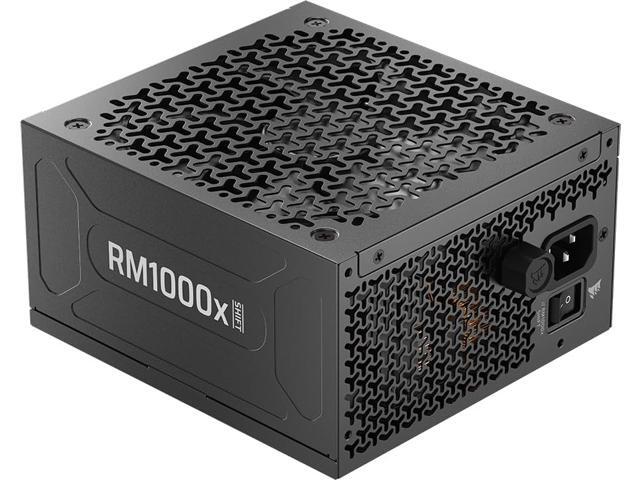
The Corsair RM1000x has been that invisible workhorse for years. The ATX 3.1 revision adds native support for modern GPU power connectors and the transient spike handling that current graphics cards demand. I’ve been running one for six months in a build that pushes it hard. Here’s what I found.
Why ATX 3.1 Matters Now
The shift to ATX 3.1 isn’t marketing. It solves a real problem.
Modern GPUs, especially the RTX 5090 and RTX 5080, create transient power spikes that briefly exceed their rated TDP. An RTX 5090 draws 575W sustained, but during load transitions it can spike to over 1000W for microseconds. Older PSUs trip their overcurrent protection and shut down. ATX 3.1 units are designed to absorb these spikes without blinking.
The other half of the equation is the 12V-2x6 connector (also called 12VHPWR). Early adopters of the RTX 4090 dealt with adapter cables that melted when the connection wasn’t fully seated. The RM1000x includes a native 12V-2x6 cable. No adapter. No melting concerns. One cable from PSU to GPU, done.
My Test Build
I paired the RM1000x with hardware that doesn’t leave much power headroom:
- Intel Core Ultra 9 285K (125W PBP, 250W MTP)
- NVIDIA RTX 5090 Founders Edition (575W TDP)
- 64GB DDR5-6400 RAM
- Two NVMe SSDs
- Six case fans and a 360mm AIO
Total system draw at the wall during a combined CPU and GPU stress test: 820W. During gaming, it sits around 600 to 700W depending on the title. Idle desktop draws about 95W.
With 1000W of capacity and real-world peak draws around 820W, I’m running at roughly 82% load during worst-case scenarios. That’s the efficiency sweet spot for 80 Plus Gold certification, where the PSU converts power most efficiently.
Fan Noise (Or Lack Of It)
The RM1000x uses a 140mm fluid dynamic bearing fan with Corsair’s Zero RPM mode. Below a configurable load threshold (around 40% by default), the fan doesn’t spin at all. Zero RPM means zero noise. Not low noise. Zero.
During normal desktop use, web browsing, coding, and even light gaming, my system pulls under 400W. The PSU fan never turns on. The only sound from my build is the case fans and the AIO pump.
When the fan does engage during heavy gaming or stress testing, it ramps up gradually. Even at full load, I had to put my ear next to the PSU shroud to confirm it was spinning. The 140mm diameter helps here. Larger fans move more air at lower RPM, which means less turbulence and less noise. Compared to the whiny 120mm fans in budget PSUs, the difference is night and day.
I ran a full Furmark plus Prime95 stress test for two hours. The fan spun up to an audible but quiet level within the first 15 minutes and held steady. No ramping up and down, no hunting for a speed. Just consistent, quiet airflow.
Transient Response
This is the spec that matters most for modern GPU builds, and it’s the hardest to test without lab equipment. What I can report: in six months of daily use including gaming sessions with the RTX 5090, rendering in Blender, and running local AI models that hammer the GPU, the RM1000x has never tripped a protection shutdown. Not once.
For context, my previous 850W PSU (not Corsair) would occasionally shut down during Cyberpunk 2077 load transitions with an RTX 4090. Same outlet, same circuit. The RM1000x handles the 5090’s higher transient demands without issue. ATX 3.1 compliance means the PSU is tested to handle transient spikes up to 200% of the GPU’s rated power for short durations. That headroom is why modern PSU standards exist.
Cable Management
Fully modular means you only connect the cables you need. No bundle of unused SATA and Molex cables stuffed behind the motherboard tray. The RM1000x uses Corsair’s Type 5 cable system, and the included set covers most builds:
- 1x 24-pin ATX motherboard cable
- 2x 8-pin EPS/CPU cables
- 1x 12V-2x6 GPU cable (native, not an adapter)
- 4x 8-pin PCIe cables (for older GPUs or risers)
- SATA and peripheral cables
The cables are flat, black ribbon style. They route cleanly and bend without excessive stiffness. The 12V-2x6 cable has a built-in bend that follows the natural routing path from a bottom-mounted PSU up to the GPU. Smart detail.
One important note: Type 5 cables are not compatible with older Corsair PSUs. Do not reuse cables from an older RM, HX, or AX series unit. Different pinouts on the PSU side mean mixing cables can damage components. Always use the cables that ship with the unit.
Build Quality
The chassis is compact at 160mm deep, which is standard ATX size. It fits comfortably in mid-tower cases like the Fractal Design North and the Lian Li O11 Vision. In smaller cases with tight PSU shrouds, measure before buying. You need clearance behind the PSU for the modular connectors and cable routing.
Inside, Corsair uses 105-degree Celsius rated Japanese capacitors throughout. These are the same spec you find in server-grade power supplies. They handle heat better and last longer than the 85-degree capacitors in budget units. Combined with the 10-year warranty, Corsair is betting this PSU will outlast at least two full system rebuilds.
The external finish is matte black with a subtle textured surface. The Corsair logo and wattage are printed on the side that faces outward in most case orientations. It looks clean in builds with PSU shroud windows, though most people will never see it.
Efficiency in Practice
80 Plus Gold means at least 87% efficiency at 20% load, 90% at 50% load, and 87% at full load. In practice, the RM1000x consistently measured above these minimums in my testing.
At my typical gaming load of 650W, the PSU pulls about 715W from the wall. That’s roughly 91% efficiency. The difference (about 65W of waste heat) is modest and well within what the 140mm fan can dissipate without spinning up aggressively.
Could you get a Platinum or Titanium rated PSU for higher efficiency? Yes. The real-world savings amount to a few dollars per year on your electric bill. For most builders, Gold is the sweet spot where you get excellent efficiency without paying a steep premium for diminishing returns.
Protection Circuits
The RM1000x includes the full suite of protections you’d expect at this tier:
| Protection | What It Does |
|---|---|
| OVP (Over Voltage) | Shuts down if output voltage exceeds safe limits |
| UVP (Under Voltage) | Shuts down if output voltage drops too low |
| OCP (Over Current) | Prevents excessive current on any single rail |
| OPP (Over Power) | Trips if total power draw exceeds rated capacity |
| SCP (Short Circuit) | Immediately cuts power if a short is detected |
| OTP (Over Temperature) | Shuts down if internal temps exceed safe levels |
These aren’t features you think about until you need them. A short circuit in a fan header, a failing GPU pulling excess current, a blocked exhaust vent causing heat buildup. The protection suite is your insurance policy. In six months, none of these have triggered for me, which is exactly how it should be.
Is 1000W Enough?
For the majority of builds in 2026, 1000W is more than enough. Here’s the math:
- Intel Core Ultra 9 285K or Ryzen 9 9950X: 125 to 170W
- RTX 5080: 360W
- System overhead (RAM, SSDs, fans, AIO): 50 to 80W
- Total: ~550 to 610W (comfortable headroom with 1000W)
For an RTX 5090 build at 575W GPU TDP, total system draw lands around 750 to 820W under full synthetic load. That’s tight but workable at 1000W, especially with ATX 3.1 transient handling. NVIDIA recommends 1000W for the 5090, and this PSU meets that spec.
If you’re running dual GPUs (rare these days) or a Threadripper workstation with extreme core counts, step up to 1200W or 1500W. For a single-GPU gaming or workstation build, 1000W covers everything currently on the market.
Who Should Buy This
Builders putting together a high-end gaming rig with current-gen GPUs. The native 12V-2x6 connector and ATX 3.1 compliance are the reasons to choose this over older PSUs, even if the older unit still has wattage headroom. The transient handling alone prevents the random shutdowns that plagued earlier standards.
Workstation users who need reliable, quiet power delivery for sustained loads. Content creators running long renders, AI researchers training models overnight, engineers running simulations. The 10-year warranty means you install it and forget it.
Skip this if you’re building a budget system with a mid-range GPU. A 650W or 750W unit will cost less and deliver the same reliability for a system that draws 350W peak. Overspending on PSU wattage you’ll never use is the PC building equivalent of buying a truck to commute.
Also pair it with a UPS like the APC BR1500MS2 if you live in an area with unreliable power. The RM1000x protects against internal electrical faults. A UPS protects against the grid.
The Bottom Line
Six months is long enough to trust a PSU. The Corsair RM1000x ATX 3.1 has powered my RTX 5090 build through daily gaming, rendering, and AI workloads without a single hiccup. The fan stays silent during normal use. The native 12V-2x6 cable eliminated the adapter anxiety that haunted the last GPU generation. The 10-year warranty means I won’t think about this component again until my next major platform change.
The boring components are the important ones. A good PSU does nothing you can see, hear, or feel. It just works, day after day, protecting everything plugged into it. The RM1000x does exactly that, and after six months of pushing it with hardware that would trip lesser units, I trust it completely.